Tampilkan postingan dengan label India. Tampilkan semua postingan

Rabu, 25 Januari 2012

Google doodle celebrates 63rd Republic Day (India)


 Times of India's News Report,
 
NEW DELHI: As India celebrates its 63rd Republic Day on Thursday, popular search engine Google dedicated its latest doodle to this theme.

Internet users can see images of elephants and tri-coloured umbrellas decorating the word 'google' in the latest doodle. Three charming and joyful elephants denote the health of Indian culture and Indian economy. All three umbrellas contain saffron, white and green colour on them that gives the look and feel of the Indian flag. The 'O' of Google appear like the Ashoka's wheel.
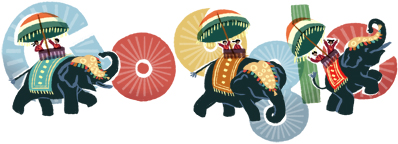
Image Credit: mostviralmedia.com


Google regularly presents to the users colourful doodles to observe birth anniversaries of important personalities and significant dates. The Republic Day of India marks the anniversary of the adoption of the Constitution of India. 


Selasa, 24 Januari 2012

India to top world in tackling slowdown

Indian Express's News Report:

The International Labour Organisation (ILO) believes India is likely to weather the latest global slowdown better than most countries, provided it ensures rising income levels for the working class and enough jobs for a growing working-age population. 

According to the annual report on global employment by the ILO, "The main challenge is not unemployment, but rather the high degree of informality that persists despite strong growth." 

"The robust growth witnessed in the South Asian region was driven largely by India and was largely due to the rapid rise in labour productivity, rather than an expansion in employment," the report, titled, 'Global Employment Trends 2012: Preventing a Deeper Jobs Crisis', said. 

Image Credit: financialexpress.com
This situation is prominent in India, which accounts for 74 per cent of the South Asia region's labour force.
In India, total employment grew by only 0.1 per cent over the five years to 2009-10 -- from 457.9 million in 2004-05 to 458.4 million in 2009/10 -- while labour productivity grew by more than 34 per cent over this period. 

Labour productivity is the amount of goods and services that a worker produces in a given amount of time.
A major reason for the slow growth in employment in recent years is the fall in female participation in the labour force. This has been most pronounced in India, where participation of women in labour activities fell from 49.4 per cent in 2004-05 to 37.8 per cent in 2009-10 for rural females and from 24.4 per cent to 19.4 per cent for urban females. 

This drop in participation can only partly be explained by the strong increase in enrollment in education, because it has been evident across all age groups, the report added. 

The main labour market challenges in South Asia, including India, are two-fold and consist of achieving the twin goals of increasing labour productivity, to ensure incomes are rising and poverty is falling, and creation of enough jobs for a growing working-age population, which is expanding by around 2 per cent each year, the ILO said. 

With almost 60 per cent of the population in South Asia under the age of 30, governments should take advantage of this demographic dividend, the report said. 

The global uncertainty stemming from the euro area sovereign debt crisis and continuing weakness of the United States' economy has negative implications for all countries, including those in the South Asia region.
"Overall, the worsening economic conditions will make it more challenging for the South Asia region to promote the creation of productive jobs in the non-farm sector and continue the battle against the persistence of informality, vulnerable employment and specific barriers for women and youth in the labour market," the report said.


Kamis, 05 Januari 2012

RAILWAYS OFFER TRAIN TICKETS ON CELL PHONE (India)

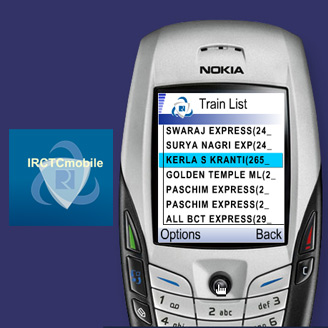
According to Times of India's News Report, booking train ticket was never so easy as you can now get it done through your mobile phone. With Google on your phone, get flight status instantly. 
 
            After initial registration and downloading of suitable software on the mobile handset with Internet facility, it will be possible for the mobile users to book a ticket through their own mobile. Launched by Indian Railway Catering and Tourism Corporation (IRCTC), a PSU under Railway Ministry, has been offering the service of booking e-ticket over the mobile phone, said a senior Railway Ministry official. 

Image Credit: www.mobiletor.c
After booking, the passenger will receive a reservation message with full details of the ticket including PNR, train no, date of journey and class. "This virtual message would be treated at par with the print-out of the e-ticket which at present is taken out by the passengers and is known as Electronic Reservation Slip (ERS)," he said. 
Hence, with the virtual message, passengers would not be required to take a print-out of e-ticket to be carried with them. Showing the reservation message of the confirmed ticket on their mobile during travel will be sufficient. Internet is required on mobile phones to book tickets through mobile. The passenger has to register at the time of first transaction and thereafter book the ticket using his ID and password. 
The service was introduced on a pilot basis for a few and now the more than a thousand users are availing this facility everyday, he said. The service charge is similar to e-tickets-- Rs 10 for Sleeper class and Rs 20 for other higher class.

Rabu, 04 Januari 2012

New law 2012 to check terror related communication (India)

New Delhi:  To check the growing misuse of Internet by terror groups, the government is planning to soon come out with a law that will make it mandatory for Internet service providers to share real time information with intelligence and security agencies.

Highly placed sources in the government said most of the information that will be sought from Internet companies will be related to suspicious e-mails, transfer of funds and other financial transactions using e-commerce.

Various government agencies are currently studying laws and regulations in other countries -- particularly in the US and European countries – that managed to rope in Internet firms in the fight against terror, sources said.

 
Image Credit: techgenie.com

The need for the law was felt in the wake of consistent complaints by security and intelligence agencies, that often Internet companies are reluctant to provide timely information, particularly during ongoing investigations in terror cases, sources said. This hampers the investigation process, they said.

Indian intelligence agencies have come across cases where funds have been transferred using the Internet, which was found to have been used by terror modules.

Further, e-mails have emerged as a preferred mode of communication among terror modules as these are much more difficult to intercept compared to mobile calls. Also, the e-mails hardly leave any footprints to trace the exact location of the users.

Now, the terrorists are also said to be using chat sites to communicate which are even tougher to intercept than e-mails.

Intelligence sources also claimed that in majority of recent terror cases, there has been considerable use of technology, particularly the Internet, by terror modules.

Even though security and intelligence agencies have been constantly upgrading their technological capabilities to meet the challenges, they feel legal support will be a shot in the arm for them.

Sources said that once the study is completed a draft note will be prepared and the issue will be discussed by the Cabinet Committee on Security and then a final decision to make a new law or amend the existing will be taken.

After Gujarat, Tamil Nadu makes chess compulsory in schools (India)

CHENNAI: 

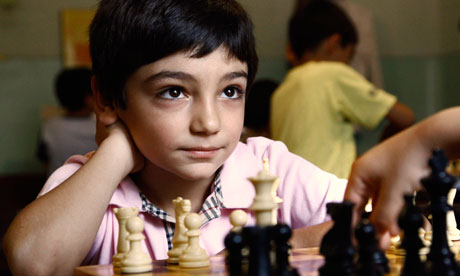
According to Times of India's News Report, Tamil Nadu has adopted Gujarat's strategy of introducing chess in all schools in an apparent bid to improve cognitive skills of students. The unique initiative, to be launched next academic year, is aimed at exposing students, especially those from "educationally backward" districts, to the rudiments of the game.

A senior education department official said the state was following up on the announcement made by chief minister J Jayalalithaa in August 2011 to start the practice in government and aided schools. The inspiration was the "chess in schools" programme run by the World Chess Federation, whose president Kirsan Ilyumzhinov had met Jayalalithaa earlier in the year.
Image Credit: guardian.co.uk

"It (the chess programme) will give children in the seven to 17 age group an opportunity to test their skills. Training will be given to physical education teachers and one or two others in each school so they can train the children," said additional chief secretary T S Sridhar. 


Kamis, 22 Desember 2011

Government asks Bharti, Vodafone, Idea to stop 3G roaming pacts (India)

 Delhi:

According to IBN Live Report, coming down heavily on operators for violating licence norms, the Telecom Ministry has asked service providers to discontinue their 3G roaming agreements and is also contemplating imposing penalty on them.

The decision comes after the unanimous view of telecom regulator TRAI, Law Ministry and DoT that such roaming agreement was in violation of the telecom licences.
Image Credit: Gizmodo

Leading operators like Bharti, Vodafone and Idea had entered into agreement with one another to offer 3G mobile services in circles in which they could not succeed in getting spectrum in the auction held last year.

"The decision has been taken that this (3G roaming pacts) is in violation of terms and conditions of the licence... will be issuing notices asking them (operators) to stop their service with immediate effect. But on penalty, no decision has been taken yet," Telecom Secretary R Chandrasekhar said.

The issue pertains to the pact among major service providers, including Bharti Airtel, Vodafone Essar and Idea Cellular, for providing 3G roaming network on a pan-India basis.

Other service providers like Tata Teleservices and Aircel had also entered into similar agreements to offer services in six circles. However, they have already discontinued the arrangement.

The Department of Telecom (DoT) had sought a legal opinion on this matter and the Law Ministry had supported the DoT's view.

In an internal note, the DoT had said the roaming agreement among telecom companies for 3G services would lead to a significant loss of revenue to the government.

source: IBN Live

Selasa, 20 Desember 2011

First US-Japan-India trilateral meeting 2011 (India)

As India, United States and Japan held their first trilateral meeting in Washington, Tokyo and Washington affirmed a deepening of strategic ties with India and made it clear the dialogue was not directed against China.
In fact after a meeting with visiting Japanese foreign minister Koichiro Gemba on Monday shortly before the official level trilateral, secretary of state Hillary Clinton said Washington supported a similar trilateral meeting between US, Japan and China as proposed by Tokyo.


Image Credit: IBN LIVE
"The United States supports a meeting between Japan, China, and ourselves, as foreign minister Gemba recently proposed," she said at a press conference after the meeting which "covered global issues like Iran's nuclear ambitions and the situation in Afghanistan."

Echoing Clinton, Gemba citing the Japan-US-India trilateral dialogue "as a specific example of collaboration" said: "On India, as the secretary suggested, we affirmed that Japan and the United States are deepening strategic relationship with India."

The meeting, at officials' level, was co-chaired by assistant secretary of state for South and Central Asia Robert Blake and assistant secretary of State for East Asia and Pacific Affairs Kurt Campbell. India was represented by Jawed Ashraf and Gautam Bambawale, joint secretaries in charge of Americas and East Asia respectively.

Later in a press release, the Indian embassy said at their first ever trilateral dialogue the three sides "exchanged views on a wide range of regional and global issues of mutual interest.

"These discussions mark the beginning of a series of consultations among our three governments, who share common values and interests across the Asia-Pacific and the globe.

"All sides welcomed the frank and comprehensive nature of the discussions, and agreed the talks help advance their shared values and interests," it said.

The group agreed to meet again in Tokyo in 2012 to continue their deliberations.

Driven by Tokyo and finalised during then foreign secretary Nirupama Rao's visit to Japan in April 2010, the dialogue is also part of New Delhi's effort to go beyond the stated Look East policy and engage North Asia as well.
The trilateral has been in the making for a long time, but the first meeting came at a time when China is becoming increasingly assertive in East Asia and the US is seeking to ramp up its engagement with the Asia-Pacific region that includes some of the fast-growing economies in the world.

Meanwhile, Hemant K Singh, former Indian ambassador to Japan and Karl F Inderfurth, former US assistant secretary of state for South Asian affairs, who have been part of the track II trilateral meetings said in a commentary that "relations between the three (nations) are in a transformational stage."

The Washington trilateral "provides an opportunity to begin the process of operationalising Indo-Pacific cooperation as a seamless construct in areas such as maritime security cooperation, counter-terrorism, counter-piracy, counter-proliferation, disaster relief and humanitarian assistance," they said.


Senin, 19 Desember 2011

Indian Women Fetch Bronze in Four-nation Hockey Tourney

According to Zee News-India, the Indian women`s hockey team notched up a facile 4-1 win over Ireland to clinch the bronze medal in the four-nation Tournament held in Parana, Argentina.


Both the teams were locked 1-1 at half time but India came back strongly in the second session to fire three goals.


The goal scorers for India were Jaspreet Kaur (penalty corner 7th min), Anuradha Thokchom (58th min), Vandana Katariya (68th min) and Ritu Rani (penalty corner 70th min), while Aine Connery (7th min) sounded the board for Ireland.


Ireland took an early lead in the seventh minute with the lone goal scored by Connery after a defensive lapse by the Indians.

India restored parity when Jaspreet Kaur found the target from a penalty corner in the 26th minute after an Irish defender obstructed Vandana Katariya in the striking circle.

India dominated the proceedings in the second half and exhibited flair as they mounted attacks with regular monotony.


The Indian forwards -- Poonam Rani, Vandana Katariya, Rani and Anuradha Thokchom -- were well supported by midfielders Asunta Lakra, Kirandeep Kaur and Ritu Rani as they engineered forays in the rival half.


Goalkeeper Yogita Bali and deep defenders Pinky Thokchom, Jaspreet Kaur and Preety Sunila Kiro stood tall and thwarted all moves by the Irish attackers. Anuradha Thokchom put India ahead in the 58th minute when she beat Ireland custodian Emma Gray with a deflection from a right flank cross.


Vandana Katariya increase the lead to 3-1 in the 68th minuyogita balite when she found the mark after a Ritu Rani-Asunta Lakra combined midfield manoeuvre. India rounded off the tally at the stroke of full time with Preety Sunila Kiro scoring from a penalty corner variation.


India thus won both the bronze medals at four nation tournaments held at Buenos Aires and Parana on this tour. The team will return from Argentina on Wednesday. In the final world champion Argentina beat South Africa 2-0 to win the tournament. 

source: Zee News ,India